In-document (cross-) references
In this article
Cross-references to list items
Cross-referencing terminological entries
This article is relevant for:
LEADER; AUTHOR
Add a cross-reference
To add a cross-reference to an element that is elsewhere in the same standards document, such as a clause, sub-clause, term entry, annex, annex sub-clause, table, figure, abbreviation, or numbered list items, select Link, then Cross-reference from the REFERENCE tab and select the element you want to cross-reference to. The label of the element will automatically be inserted in your text.

Please note
- The label of the cross-reference will automatically be updated should the referenced element change numbering
Cross-reference an annex
When creating a cross-reference, you can use the Annex option to quickly find annex-related content.
Selecting Annex filters the list of available elements so that only: annexes; and subclauses within annexes are displayed.
Select the annex or annex subclause you want to reference and insert the cross-reference as usual.
This filter makes it easier to find and manage references to annex content, especially in documents containing many clauses and elements.

Cross-references to list items
Please note
- Only numbered list items can be cross-referenced; non-numbered items cannot.
When creating a cross-reference to a list item, the reference identifies the context in which the list appears as well as the list item.
For example:
- Table 3, list item a)
- 8.4, Note 1, list item a)

This makes it possible to distinguish between list items that appear directly in a clause and list items contained within other elements.
Cross-referencing terminological entries
To cross-refer to an existing term entry under Terms and definitions, select the word or phrase, and either :
- go to the INSERT menu, and click on the Term entry drop down arrow and select Link to existing term entry
- go to REFERENCE menu and select Link to existing term entry

To convert any word or phrase into a term entry in your draft, select it, go to the INSERT menu, and click on Term entry. The selected word is added as a new term entry under Terms and definitions clause and it is also automatically cross-referenced to the newly created term entry.

Cross-reference text preservation for term entries
When cross-referencing existing text to a term entry, OSD preserves the selected text exactly as written in the document. This includes variations such as singular and plural forms, such that if the text in the document uses a plural form when linking to a term entry, the cross-reference keeps that plural form rather than replacing it with the form used in the term entry.
For example, if the term entry is “mountain” but the text in the document is “mountains”, the cross-reference keeps “mountains” as the displayed text while linking it to the “mountain” term entry.
This ensures that creating a cross-reference does not change the wording or grammatical form of the surrounding text.

Modify cross-references
To change a cross-referenced element, click on the cross-reference and select Edit. The cross-reference modal will open and another element can be selected to link (cross-reference too).

Remove cross-references
To remove a cross-referenced element, click on the cross-reference and select Remove. The link to the cross-referenced element will be deleted.

Related articles
- To add a reference to a standard, book, journal or website, refer to the article Add normative and bibliographic references
Find cross-references for an element
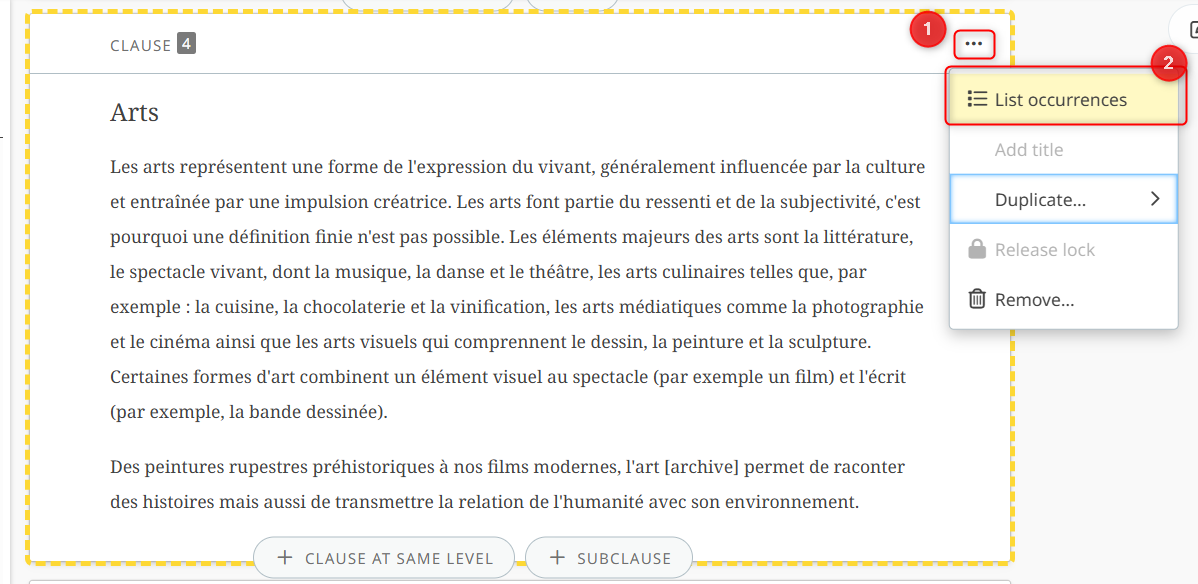
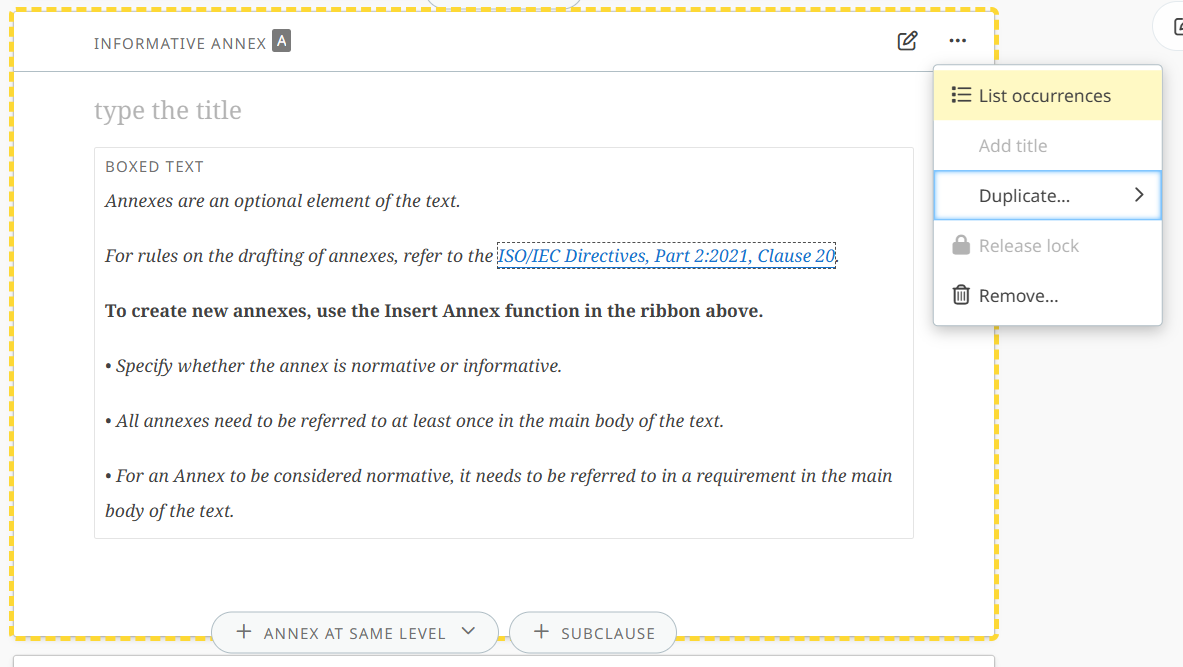
To identify all cross-references made in the document to a specific element, click on the three dots menu for the relevant element and select List occurrences

The following window will show you where in the document the element has been referred to and how many times. In this example, Table 3 has been referred to 3 times, twice in 6.1 and once in Clause 7.

Find cross references of clauses and sub clauses
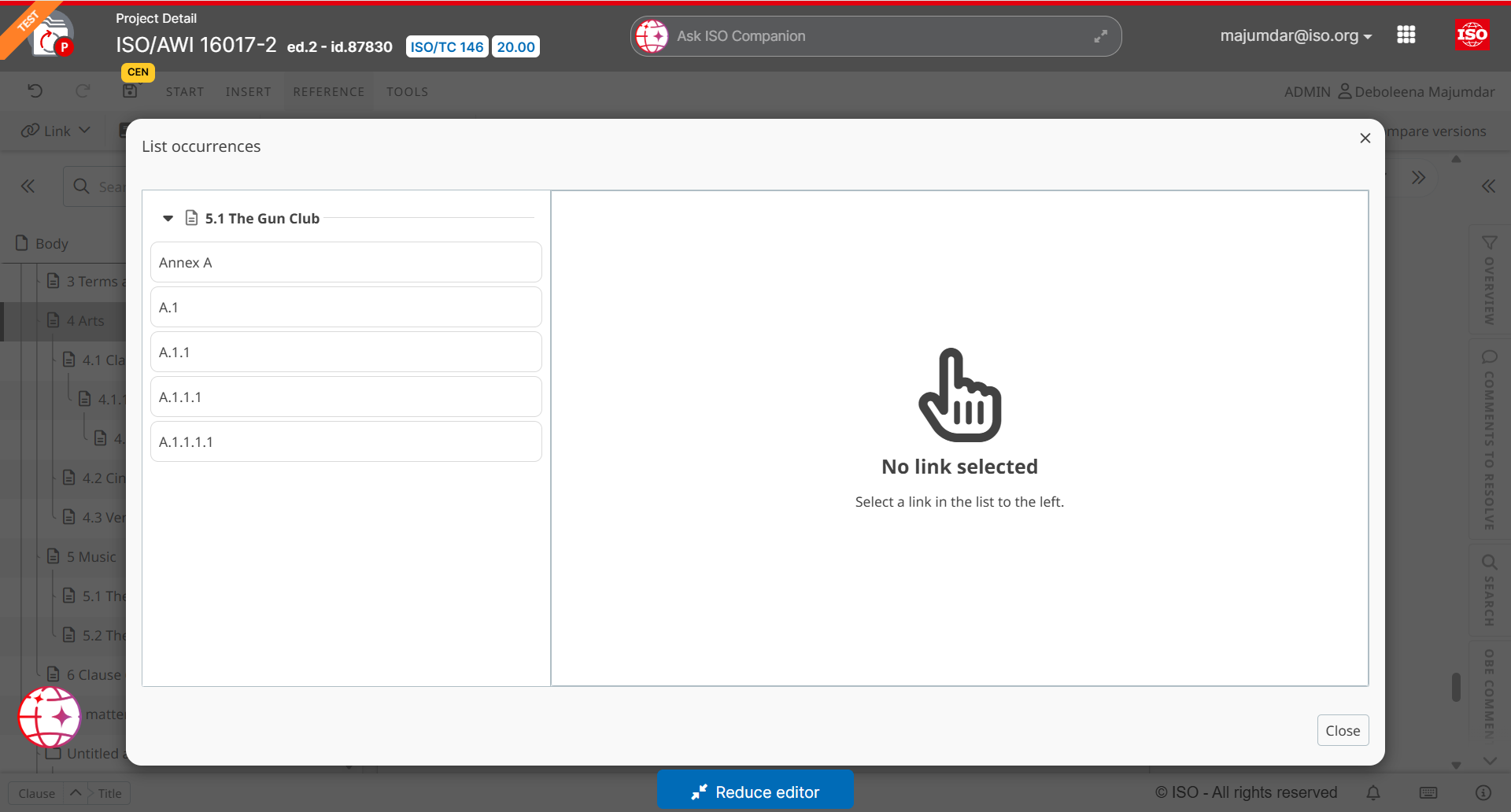
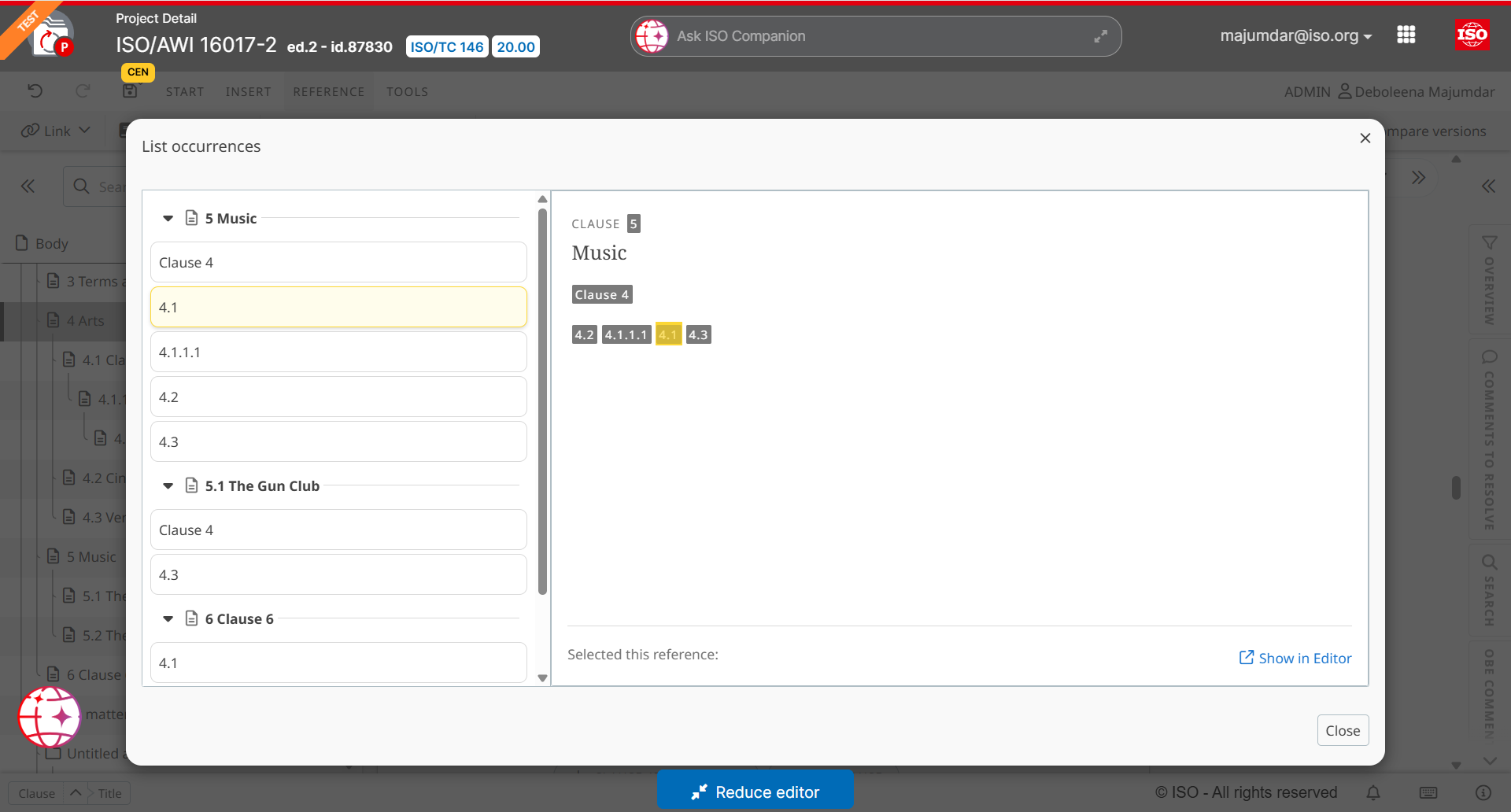
You can also view how many times a specific clause has been cross-referenced throughout a document, including all of its subclauses and numbered paragraphs. This functionality is available for both regular clauses (and their subclauses and numbered paragraphs) as well as for Annexes, including their subclauses and numbered paragraphs.
To find this information:
- Navigate to the clause or annex you want to review.
- Open the More options (three-dots) menu.
-
Select List of occurrences.
At clause level:
At Annex level
The resulting list will displays not only where the selected clause or annex has been referenced, but also every reference to its subclauses and numbered paragraphs across the document. Clicking on the Show in Editor link will navigate the user to the specific place where the clause, annex, sub-clause, or numbered paragraph has been referenced.
At clause level
At Annex level