
Content quality check
This article is relevant for:
LEADER
Content quality check - overview
The OSD platform includes a set of inbuilt checks and rules based on ISO/IEC Directives, Part 2 and ISO house style that assist authors draft their standards so that certain content quality issues can be addressed from the earliest stages in the development of a document.
Currently, the following categories of content quality check are available in the platform:
| Internal references |
Ensures that all internal cross-references within the document are correct. Checks for:
|
| External references |
Verifies that all external references comply with the rules for standard references. Checks for:
|
| Term references |
Ensures correct referencing of terms within the document. Checks for:
|
| Provisions | Detects words like “shall", or "may” in specific elements and clauses of the document, where they are not allowed. |
| Terminology rules and usage | Checks related to terminology rules. |
| Spelling and language | Checks spelling against British English and inclusive language. |
| Document structure |
Checks unsupported structure of the document. It searches for untagged keywords (e.g. notes, examples), too many levels of subdivision, isolated subclauses and hanging paragraphs, and unsupported elements that may be introduced through imported content (such as mixed lists, empty paragraphs, including those nested within container elements, and extra spaces in content). See note below. |
| Legal, CA and MSS | Highlights words related to conformance, legal, patents, management systems, copyright, etc. |
| Standardized conventions | Rules based on ISO/IEC dictionaries. |
| Ignored suggestions | Groups previously ignored quality check suggestions. |
Please note
The following additional document structure related checks are available:
-
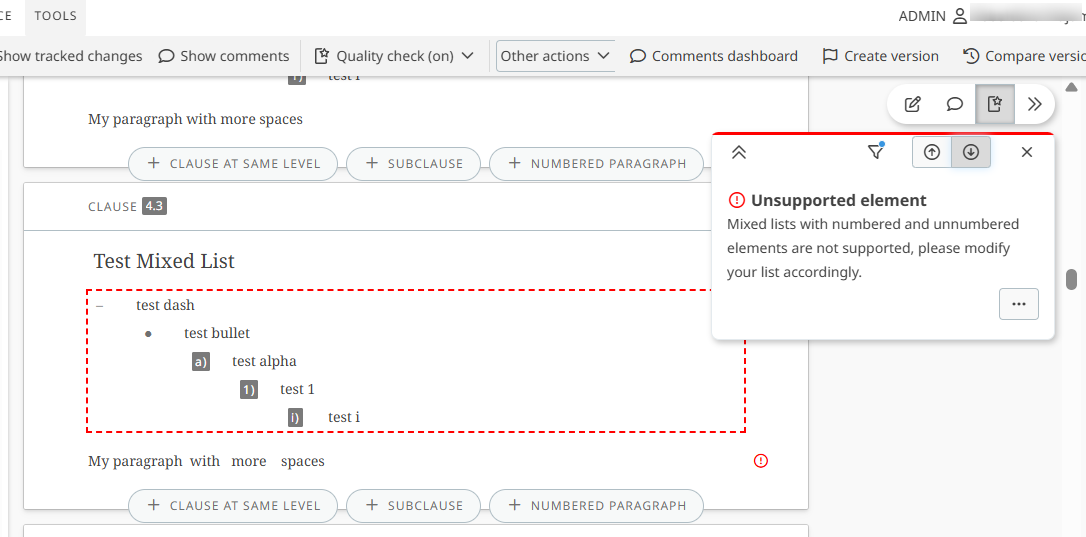
Mixed lists: Detects lists that contain a mixture of list types or inconsistent list structures. While mixed lists cannot be created directly in the OSD editor, they may be introduced when content is imported into the platform.
-
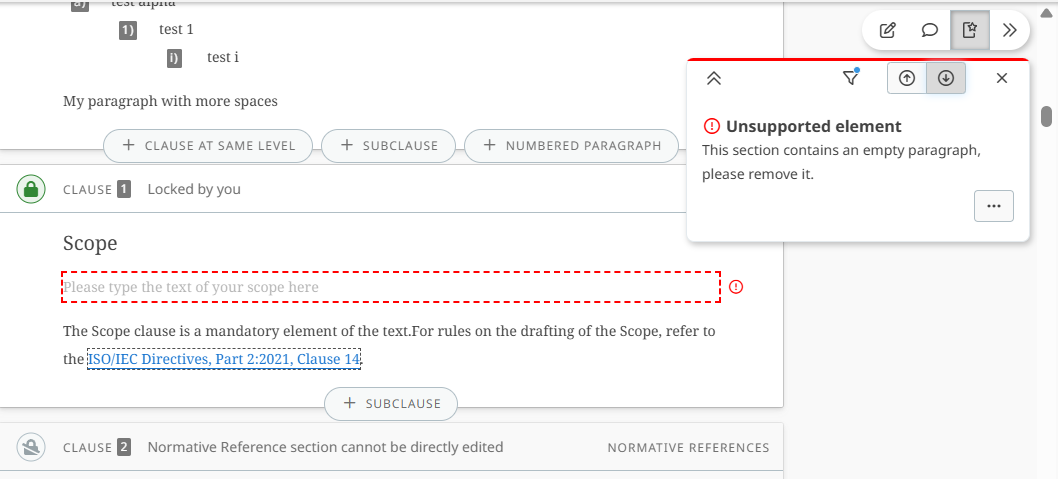
Empty paragraphs: Detects empty paragraphs, including empty paragraph elements nested within any container element. These can be both created directly in the OSD editor, or introduced through imported content and may affect document structure and formatting.
-
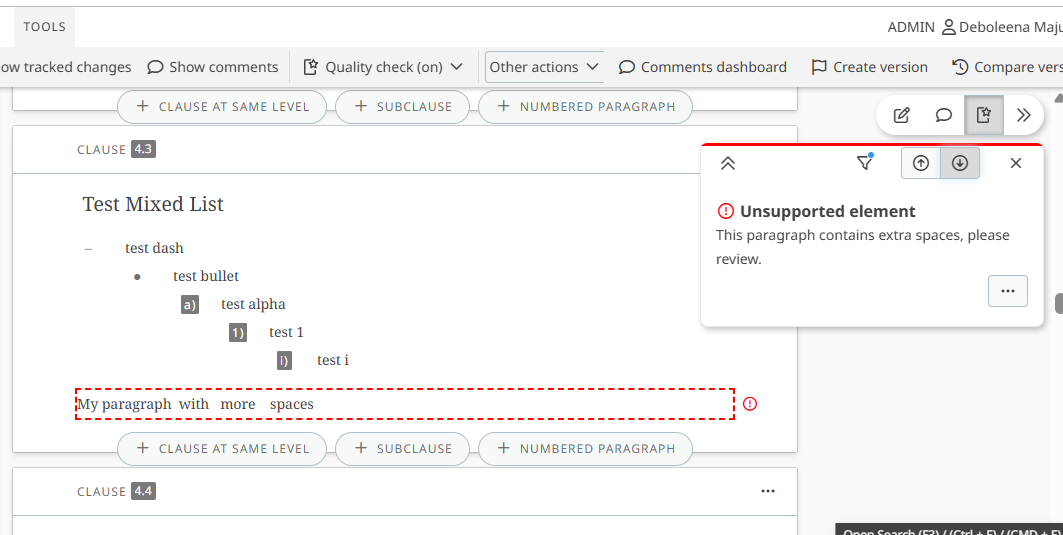
Extra spaces in content: Detects multiple consecutive spaces or unnecessary whitespace within content. Although extra spaces cannot be created directly in the OSD editor, they may appear in imported content and can lead to formatting inconsistencies.
Turn on content quality check
The content quality check can be turned on from the Tools menu or from the bubble menu.
By default, the quality check is turned off.

The following filters are available under the content quality check:
- Internal references
- External references
- Term references
- Provisions
- Terminology rules and usage
- Spelling and language
- Document structure
- Legal, CA, and MSS
- Standardized conventions
- Gender responsive terms
- Ignored suggestions

The following video shows an overview of the content quality check in the tool and how it works:

Turn off content quality check
The content quality check can be turned off from the Tools or bubble menu.

Quality check on a section of the document
The quality check can be used on a section of the document. To do so, go into the quality check filters and click on Make selection:

There will be a pop-up below in which it is possible to select the sections on which the quality check is to be run (they will appear with check marks ✓). Once the selection has been made, click on Apply to start the check on these sections.
